|
Surface stress associated with kilometer-size thermal convection
reaches the threshold value required to raise dust from the surface
(Figure 5). It is expected that, if
convection appears in the presence of a large-scale background wind,
superposition of convective and background winds enables surface
stress to exceed the threshold value more easily. In this section, we
will examine a possible value of surface stress which may be achieved
when kilometer-size thermal convection and a large-scale background
wind coexist. Since the existence of a background wind affects the
convection field, it is unclear whether a simple superposition of
winds can be applicable to a reality. However, it may be useful in
recognizing a plausible amount of possible surface stress.
An estimate of large-scale background wind velocity can be obtained as
a result of a numerical simulation by using a GCM. In the GCM
simulation of a dust-free Martian atmosphere
by Joshi et al. (1997), the
daytime horizontal wind at z= 250 m is about 26 m sec-1,
and the corresponding value of surface stress is 0.015 Pa. From these
values, the large-scale wind speed that is expected at the lowest
level of our model, i.e., at the height of 1.5 m, can be estimated by
the bulk formula. Assuming that the atmosphere is in neutral
stratification, the wind speed at a height of 1.5 m is given as
Here,
 is the Kármán constant and
 is atmospheric density.
In the above estimation, we have adopted
= 0.35 and
= 1.5×10⁻² kg m-3
which is calculated from daytime surface temperature.
is atmospheric density.
In the above estimation, we have adopted
= 0.35 and
= 1.5×10⁻² kg m-3
which is calculated from daytime surface temperature.
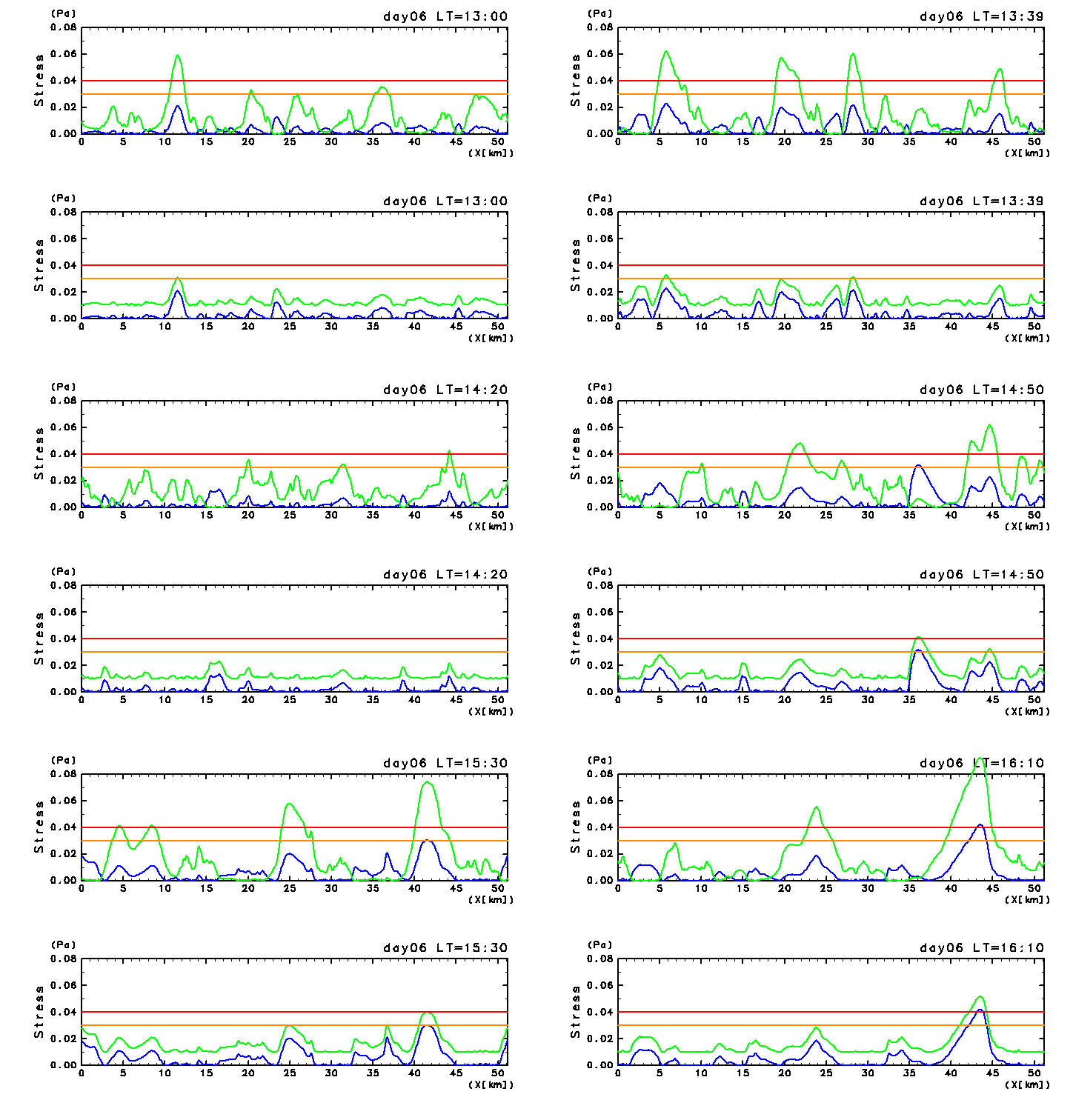
Figure 6 (upper panel) shows the magnitude of
surface stress that would be realized when a 10 m sec-1
background horizontal wind is superposed on the wind associated with
kilometer-size convection in the direction parallel to it. It is shown
that the value of surface stress frequently exceeds the threshold
value required to raise dust. However, in the presence of a background
wind, there is a tendency that the axis of convection is located in
the direction parallel to the background wind
(Asai, 1970). It may be more plausible
that the convective wind is in the direction perpendicular to the
background wind. In this case, the magnitude of surface stress
(Figure 6 (lower panel)) is reduced compared to the
case of parallel superposition. However, there are occasions when the
value of surface stress exceeds the threshold value.
|
|
Figure 6: Horizontal distributions of surface stress magnitude
(absolute value) from 13:00 to 16:10 LT. (Upper panel) A background
wind is superposed in the direction parallel to the convective
wind. (Lower panel) A background wind is superposed in the direction
perpendicular to the convective wind. Green lines indicate the
superposed surface stress, while blue lines indicate the results of
model output only. Orange and red lines show the minimum and maximum
values, respectively, of the threshold surface stress required to
raise dust from the surface
(Greeley and Iversen, 1985).
|
|


