|
4.a. Features of Dust Mixing (2)
|
|
|
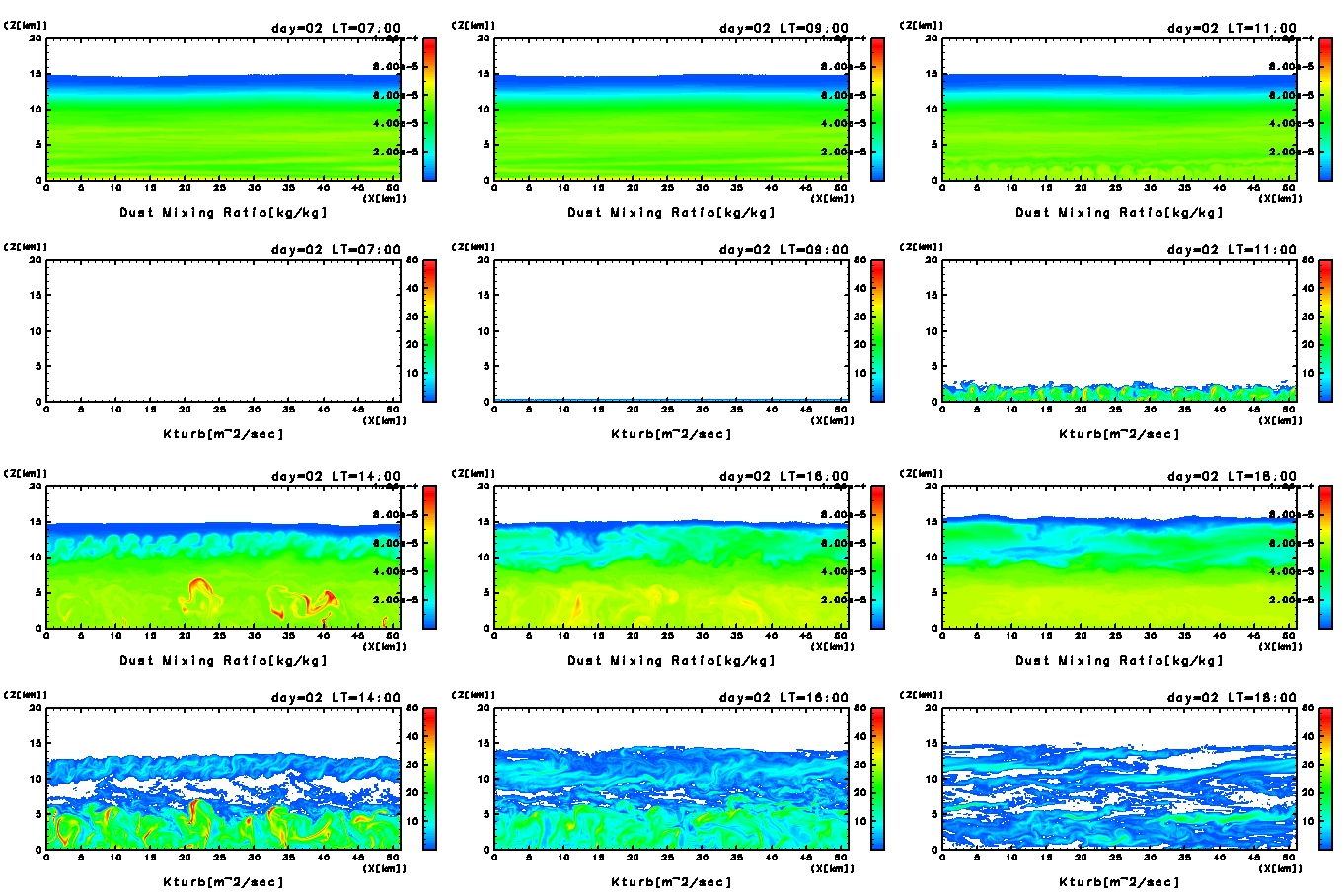
Figure 10b : (Upper panel) Dust mixing ratio (kg/kg). Areas
with a mixing ratio larger than 1.0×10⁻⁸ are
colored. (Lower panel) Turbulent diffusion coefficient (m2
sec-1). Areas with a value larger than
1.0×10⁻⁵ are colored. All results are for day 2
after dust injection initiation every 1 hour from 7:00 to 18:00 LT.
|
Dust, when mixed and thoroughly distributed up to 10 km, is further
transported upward into the stratosphere. Figure
10b (upper panel) shows the distribution of dust mixing ratio for
day 2 after dust injection initiation. In the afternoon, at altitudes
near 10 km, dust propagates upward in the form of plumes.
Distribution of the turbulent diffusion coefficient
(Figure 10b (lower panel)) suggests that these
plumes are accompanied by a vertical mixing process that differs from
that of the kilometer-size thermal convection near the surface.
At altitudes near 10 km, vertical mixing is caused by a vertical
difference of radiative heating associated with the vertical contrast
of dust density. As a result of dust injection and mixing on day 1, a
region with a large vertical gradient of dust mixing ratio forms at
altitudes from 11 to 13 km (Figure
11a). Associated with this gradient, a large difference of solar
radiative heating can be observed in regions below 13 km
(Figure
11g, Figure 11h). Consequently,
an inversion of potential temperature occurs at a height of
approximately 10 km, and the layer between 10 km and 13 km becomes
convectively unstable. The vertical distribution of horizontal mean
potential temperature (Figure 11d
(right panel)) shows that this unstable layer is rapidly
stabilized and potential temperature from 10 to 15 km becomes
vertically uniform. The upward transport of dust into the stratosphere
is a direct result of the heating of dust solar absorption; dust is no
longer a passive tracer in this region.
The vertical profile of horizontal mean dust mixing ratio does not
significantly vary on or after day 4
(Figure 11b). In the convection
layer, dust mixing ratio slightly increases as depth of the convection
layer decreases. In the region above the convection layer, dust mixing
ratio slightly decreases due to the gravitational sedimentation of
dust.
|


